GEOTECHNICAL ENGINEERING / PILE DESIGN
Know what your pile can carry.
Evaluate pile bearing capacity based on soil conditions, foundation geometry, and safety factors.
Details
Enter the relevant geotechnical parameters, define your pile dimensions, and specify the applied load to assess foundation performance and support informed engineering decisions.
Understand your soil.
The strength and characteristics of the surrounding soil play a critical role in determining pile capacity.
Define soil unit weight, cohesion, friction angles, adhesion factor, and groundwater depth to establish the geotechnical conditions used in the calculation.
Define your foundation.
Pile geometry and installation depth directly influence the foundation's load-bearing behavior.
Select the pile shape, specify its width or diameter and embedment depth, and enter the applied load including the pile's self-weight.
Design with safety in mind.
Safety factors account for uncertainties in soil conditions, material behavior, and load resistance.
Specify the appropriate base and shaft safety factors to evaluate the allowable pile capacity and assess the foundation against the applied load.
SF
GEOTECHNICAL ENGINEERING / CAPACITY RESULTS
From ground conditions to bearing capacity.
Understand how soil properties, pile geometry, and safety factors influence your foundation's load-bearing performance.
Details
Review calculated base resistance, shaft resistance, ultimate bearing capacity, and allowable load to evaluate the pile's response to the applied load.
Review your design assumptions.
The calculated results depend on the soil properties, groundwater conditions, pile dimensions, applied loads, and safety factors entered on the previous page.
Verify that all input values and measurement units are correct before interpreting the bearing capacity results.
Coefficient of Earth Pressure Ks
LESS LIGHT
Earth pressure coefficient used in the shaft resistance calculation.
Base Resistance Qb (kN)
LESS LIGHT
Ultimate resistance developed at the pile base.
Shaft Resistance Qs (kN)
CENTRE
Ultimate resistance generated along the pile shaft.
Total ultimate resistance Qu (kN)
MORE LIGHT
Combined ultimate resistance from the pile base and shaft.
Allowable Load Qa (kN)
MORE LIGHT
Estimated allowable load after applying the selected safety factors.
Understanding pile resistance
Pile bearing capacity is determined by two primary resistance components: base resistance and shaft resistance.
Base resistance (Qb) represents the load supported at the pile tip, while shaft resistance (Qs) represents the resistance mobilized along the pile-soil interface.
Together, these components determine the total ultimate resistance (Qu). The allowable load (Qa) is calculated using the specified safety factors and can be compared with the applied load to assess the preliminary capacity condition.
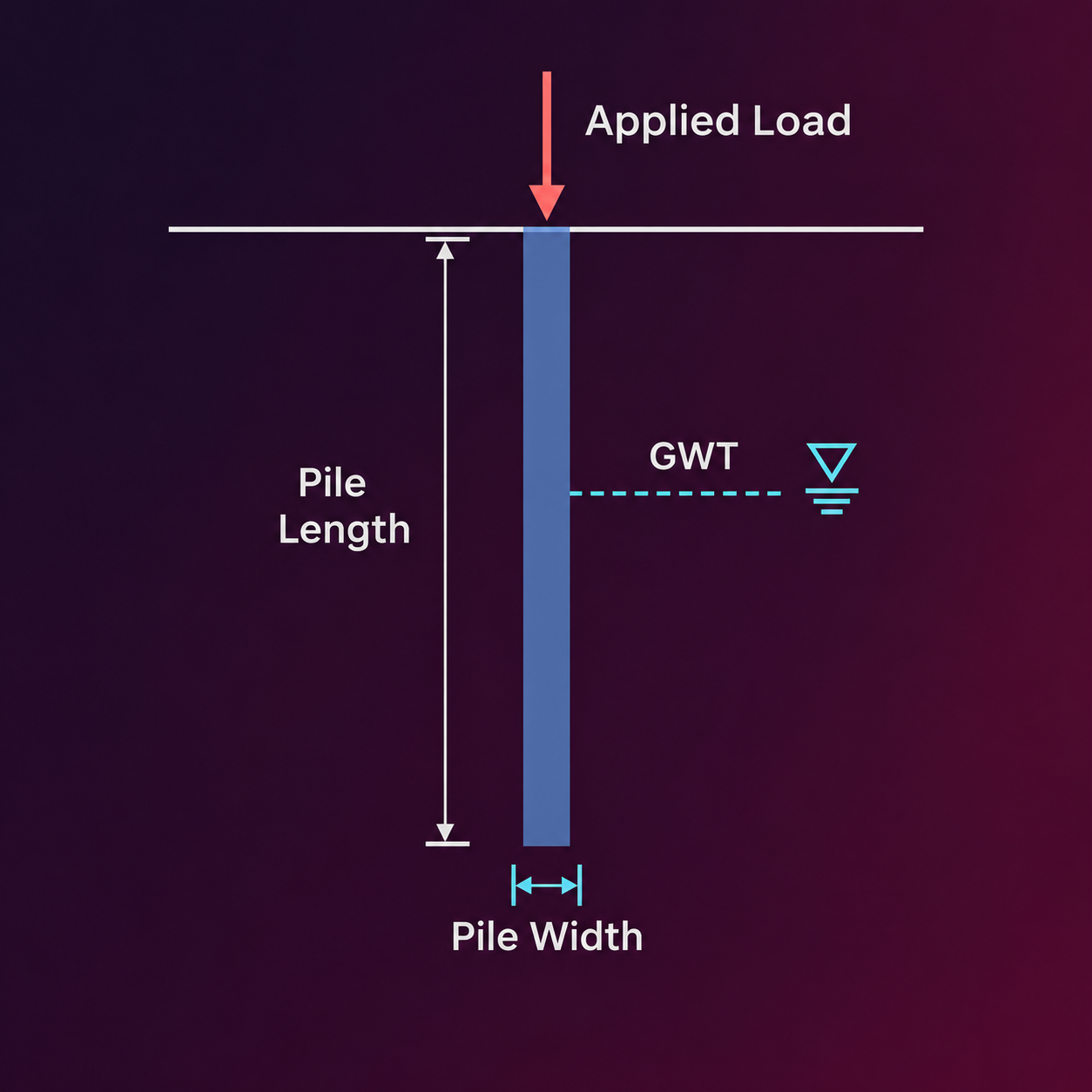
Evaluate your foundation capacity.
Compare the calculated allowable pile load with the applied load to assess the foundation's preliminary bearing capacity.
The safety assessment considers the contribution of base and shaft resistance along with the specified safety factors. These results support preliminary engineering evaluations and should be verified against applicable geotechnical design requirements.
**Disclaimer: The information provided by this calculator is intended for informational and educations purposes only. The default figures shown are hypothetical and may not be applicable to your individual situation. We are not responsible for the consequences of any decisions or actions taken in reliance upon or as a result of the information provided by this tool. We are not responsible for any human errors or omissions.
Stripe Connector Payment
